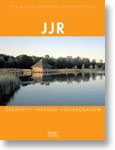
Intro text for one of four JJR practice areas:
Waterfronts
We live in a land rich with water. Throughout history, our nation's oceans, lakes and rivers have served as a vital transportation network, moving people, hauling raw materials, shipping finished goods. It's no surprise our cities have grown up along its shores. But over the decades, our reliance on water has changed. Railroads, then highways, evolved into our major transportation routes.
Our attitudes about water have changed, too. No longer viewed as just a commodity or convenience, water has become an increasingly valuable recreational resource. We seek it out--we want to walk along its shores, gaze out across its surface, fish, sail, sun and swim. In recent years, the public has demanded better access to its waterways, in terms of pedestrian routes, waterfront parks, harbor facilities and more.
Many cities still need to catch up with this change in values. They continue to turn their backs on their waterfronts, which remain lined with ramshackle warehouses, derelict ports, abandoned railroads and other impediments.
This presents an enormous and exciting opportunity, one we welcome at JJR. Maybe it's our Michigan roots, a state blessed with thousands of miles of shoreline. Maybe it's our firm's history of seeking out those projects that are a bit more complex and challenging. Almost from JJR's very first years, we've tackled these thorny waterfront redevelopment projects, first with Chicago's Jackson Park in the early 1960s, and more recently with success stories like Racine's Festival Park and Chicago's Navy Pier.
With our firm's multi-faceted studio organization, we are ideally suited to waterfront development work. JJR has all the resources--from engineers to fisheries biologists to regulatory specialists--to address the many complexities inherent in these projects. We overcome industrial pollution problems, land-ownership issues, conflicting uses, and a host of other constraints to create renewed, re-energinezed waterfronts that are structurally sound, environmentally sensitive and aesthetically pleasing. We are absolutely determined and dedicated to make the most of this incredibly valuable asset.
In cities large and small, we've taken the cluttered canvas of aging, abandoned industrial shorelines and transformed them into places where people are reconnected with their waterways for recreation, reflection and a wide range of community gatherings. In many places, these revitalized waterfronts now serve as the pulse of their communities, alive with festivals, concerts and outdoor enthusiasts young and old.
And like a stone cast in the water, the ripples soon extend to benefit the entire area. Time has shown that JJR's well-planned waterfront developments lure people back to the heart of the city. Their interest spurs residential development, prompts new shops and restaurants, attracts service businesses, builds tourism and convention interest, and so on, and so on...creating a vitality as refreshing as the water itself.
Featured Project: Lake Forest
Concerned with the severe erosion of its Lake Michigan beach, the city of Lake Forest, Illinois, retained JJR as part of a multi-disciplinary team to investigate ways to restore, protect and enhance this beloved community resource. JJR's unusual plan initially raised some skepticism--but the end result was a tremendous success that returned Lake Forest's beach to its residents for generations to come.
Once a broad ribbon of sand at the base of a bluff, Lake Forest's 3,400-foot shoreline at Forest Park Beach was slowly devoured by a combination of record-high lake levels, wave action, storm damage, and nearby man-made structures that cut off natural sand deposits known as "littoral drift." Consequently, by the mid-1980s, the sandy beach that once graced the bottom of the Forest Park bluff was reduced to a thin line gravel just a few feet wide.
JJR's master plan called for offshore rubble-mound breakwaters and onshore stone revetments to dissipate the energy of incoming waves. The beach would be restored by adding sand along the shoreline in a scalloped pattern, and allowing natural wave action--diffracted and weakened by the breakwaters--to shape it.
Sophisticated computer modeling indicated such a design would be effective. But to offer further proof, JJR conducted hydraulic model testing, using a 100-foot by 100-foot wave tank with lake bottom topography and shoreline contours that exactly replicated Lake Forest conditions.
The plan did indeed work brilliantly, returning the wide, soft beach prized by Lake Forest residents--one that has withstood subsequent years of exposure to wind and waves. With significant community input, the next phase of JJR's plan added several amenities to the renewed lakeshore, including a protected boat basin and launch area, beach house and landscaped lawn area, wood walkways and overlook decks, and a popular waterfront promenade.

JJR firm history
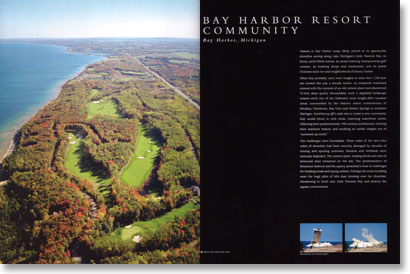
Client: JJR LLC
Project: JJR: A History of Defining Places, a hardcover book detailing JJR's history and growth from landscape architecture firm to multi- disciplinary design firm involved in large-scale urban renewal and development projects.
Task: Research and write the 265-page book, based on on-site visits and interviews with employees and clients. The text highlights dozens of projects in four key areas: Livable Campuses, Sustainable Environments, Vital Cities and Waterfronts.©Tina Lassen. All rights reserved. Any use of this text, in whole or part, without written permission of the publisher and author is prohibited by law.