Along Amish Byways
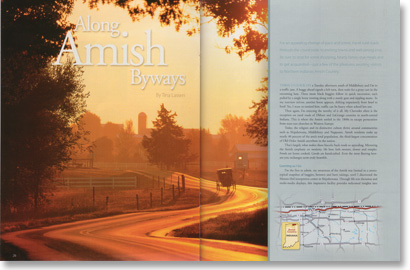
Three o'clock on a Tuesday afternoon south of Middlebury and I'm stuck in a traffic jam. A buggy ahead signals to make a left turn, then waits for the pony cart clip-clopping past in the oncoming lane. Three more black buggies follow in quick succession, each pulled by a single horse trotting along with a sturdy gaze and rippling mane. And in my rear-view mirror, another horse appears, twisting his head and shifting impatiently from hoof to hoof. Yes, I want to remind him, traffic can be heavy when school lets out.
Then again, I'm enjoying the novelty of it all. My Subaru is often the exception on the rural roads of Elkhart and LaGrange counties in north-central Indiana. This is where the Amish settled in the 1840s, to escape persecution from state-run churches in Western Europe. Today, the religion and its distinctive culture thrive in towns like Shipshewana, Middlebury and Nappanee; Amish constitute nearly 40 percent of the region's population, the third-largest Amish area in the nation.
And it's largely what makes these bucolic backroads so enjoyable for a few days' getaway. Mirroring the Amish emphasis on modesty, life here feels sweeter, slower, simpler. Foods are homecooked. Goods are handcrafted. The most fleeting exchanges--How are you?--seem heartfelt. Cultures here don't collide, they coexist and complement, creating a wonderfully unique slice of Americana.
•••
I'm the first to admit, my awareness of the Amish faith and culture was limited to a stereotypical snapshot of buggies, bonnets and barn-raisings. That's why I was delighted to find the Menno-Hof Interpretive Center in Shipshewana. Through life-sized dioramas and multi-media displays, this impressive facility provides welcome education and insights into the faith and lifestyle of Anabaptist communities, which include Amish and Mennonites. It's the perfect place to begin your Amish country visit.
"The Amish are not pioneers," explains the center's director, Joseph Yoder. "It's a culture and a religion that chooses not to use certain modern conveniences. This center tells their story in a well-researched, creative way without invading their privacy as they go about life in a place like Shipshewana."
"I've been to the Amish country in Pennsylvania and not run into anything like this," exclaimed Rosemary Martin of Baltimore, visiting the center with childhood friend Ellen Mallery of Minnesota. "It's just wonderful."
Shipshewana is the center of goods and services for many of the Amish families in the region. In nearby Yoder's Department Store (Yoder is one of a handful of Amish surnames you'll run across again and again), the young woman working behind the counter could be a model for the clothes on the racks. She wears a simple pastel dress, white bonnet and clunky black shoes. Her outfit and the store's other goods--bolts of fabric, hand tools--are all a testament to the principles I learned about at the center: modesty, simplicity, self-sufficiency.
Generosity, not modesty, must be the Amish virtue that dictates food portions. My omelet this morning looked like a catcher's mitt smothered in cheese; now the wafting aroma of warm cinnamon lures me into the Bread Box Bakery and Café in the heart of Shipshewana's shopping district. I marvel at pastry cases lined with tidy rows of breads, cakes and fruit pies, opting for a softball-sized iced cinnamon roll. Rich, warm and gooey, it's heavy enough to taco the paper plate on which it arrives.
Outside on Morton Street, I join the other shoppers, most of whom seem to be strolling along with some sort of decadent snack--pie slices, soft pretzels, sweet kettle popcorn. Like most of the towns in Amish country, you won't find either trendy wine bars or tired franchises in "Shipshe" (especially the wine bars--the town is dry). Instead, dozens of locally owned specialty shops line the downtown streets, offering everything from garden art to string instruments to renowned Amish quilts and hardwood furniture.
It was beautiful stuff, to be sure, but I was even more intrigued by the everyday Amish goods. At E&S Bulk Foods, I stumble upon a collection of great cookbooks and Amish home remedies. (For an upset stomach, drink hot water with nutmeg; for poison ivy, make a compress of cornstarch and poke berries.) The hardware store prominently displays kerosene lanterns and saddle supplies. Even the parking lots are interesting, filled with a hodgepodge of cars, bicycles--none of which are ever locked--and buggies with their waiting horses. Does your bank have a hitching post?
Good luck making any progress at all driving outside of town, where handmade signs conspire to lure you down every side road: Buggy Repair. Homemade wooden toys. Rag rugs. See noodles being made! I bite at the sign for Owl Toycraft, and head down a dirt lane west of Emma. No one is around, but the woodworking shop is filled with the smell of fresh sawdust and signs of someone's skill: Miniature stockyards with stalls and pens, horse stables, tractors, hip-roof barns, even tiny wooden milk cans.
As for the noodles, you can indeed watch them being made at the Dutch Country Market east of Middlebury. You can also savor them almost anywhere; rich egg noodles are a staple of the all-you-can-eat, family-style dinners at dining institutions like Das Essenhaus in Middlebury. But for a more intimate experience, plan to have dinner in an Amish home. Arrange one through Miller's Buggyline Tours (available Tuesdays and Wednesdays), and you get to travel there by Amish buggy, too.
Buggy driver Lewis Hochstetler genially answers questions about Amish life as four of us roll along the side of the highway to Lavoyd and Loretta Schlabach's farmhouse. Soon we're gathered around a long and lovely oak table as plates circle almost incessantly, heaped with fried chicken, egg noodles, mashed potatoes, homemade bread and two kinds of pie. We discuss everything from South American travel to alternative fuels, shattering my stereotypes along the way.
I'm back in Shipshe the next morning for its well-known Wednesday Antiques Auction. At 8 a.m., a bell sounds and a din erupts, as eight auctioneers scattered throughout the football-field-sized building spring into action at once, bellowing their trademark singsong through tinny speaker systems. "Five dolla, five dolla, gimme a tenner!" "Fif, fif, fif, fifty dollar bill here!"
The cacophony is deafening and the assortment of goods staggering. I wander past bookcases, baseball cards, bowling pins and birdcages. A sequined accordion. Indian artifacts. Some of the strangest lamps I've ever seen. A Chicago antiques dealer snaps up a tin monkey for $10 and an oil painting of the Queen Mary for $17. I can only imagine the prices they'll fetch next week along Belmont Avenue. I get caught up in the fun and emerge with two geography books from the 1880s for $8.
Next door, the weekly livestock auction is just getting underway. I grab a spot in the bleachers amid Amish straw hats and Stetsons, and watch as farm hands usher squealing piglets, dairy calves, goats and sheep into a small ring in rapid succession. Each seems to be purchased just as quickly, before I can even make out the price the auctioneer is chanting.
I head southwest toward Goshen for a little exercise. Here the 13-mile Maple City Greenway wanders past the Mill Race Farmer's Market and links up with the Pumpkinvine Trail, a converted rail lane that will eventually stretch all the way to Shipshewana. Rather than an Amish influence, the home of Goshen College exudes an eclectic college-town feel, with artsy coffee shops, old-fashioned soda fountains and inventive restaurants like the Blue Gill all sharing the same zip code. My favorite stop is the police bunker on the corner of courthouse square, built to protect downtown banks from a roving John Dillinger.
From Goshen, it's just 14 miles to Nappanee. I pop in the Heritage Trail CD, which narrates a 90-mile loop route along the Amish byways. The two discs describe point-to-point attractions, as well as all sorts of interesting tidbits about area culture and history. I'm not sure I would've noticed Amish "bank barns" on my own, built against hillsides so farm wagons can be used on two levels.
But it would be surprising if Amish farms didn't catch your eye. They uniformly look as tidy as a pressed linen shirt--bright white with freshly painted picket fences, laundry flapping on the line, impeccably stacked firewood and the most remarkable flower gardens I've ever seen. "People ask how we keep our yards so clean," Lewis the buggy driver remarked the night before with a wry smile. "I tell them, 'Why, that's our television time.'"
Perhaps that also explains the celebrated woodworking skills of the Amish. Nappanee became one of the nation's leading furniture producers nearly a century ago. Today Amish craftsmen create hardwood heirlooms of cherry, oak and maple in both factories and small "shingle shops" scattered along country roads around Nappanee.
Down the road at Amish Acres, school kids fan across the grounds of this restored Old Order Amish farmstead. Craft demonstrations, buggy rides, farm tours offer a glimpse of daily life on the farm. The 80-acre complex also includes restaurants, inns, shops and a theater.
Leaving Amish Acres, I steer down random, unpaved roads to hopscotch my way northeast. Since most of the region's roads are on a grid, it's easy to keep your bearings. Besides, I enjoy these country lanes, where the only sounds are the whir of crickets and the distant click of horse hooves, where squiggles in the dirt show the path of the buggy that went before me. I happen upon a baseball game at an Amish school, young boys all in matching coveralls, white shirts and straw hats. I resist the urge to snap a photo out of respect for Amish beliefs, but pull over long enough to soak in the scene and cheer on a base hit.
It's dark when I arrive at the Checkerberry Inn, its windows radiating a golden glow as I crunch gravel up the long drive. Inside, the 14-room guesthouse exudes warmth and comfort, thanks to a polished staff that masterfully walks that invisible line between laid-back and luxurious. Within minutes of arriving, I'm sipping a big globe of zinfandel as innkeeper Karen Kennedy shows me around--past the library, with its walls of glass overlooking the pool, past Citrus, the inn's acclaimed bistro, and to my oh-so inviting room, with its plump down duvet and padded window seat. By the end of the evening, I've enjoyed a truly outstanding meal and feel as if I've been transplanted to Provence.
In the morning, I snuggle into the sunny window seat with a strong mug of steaming coffee. I gaze out across a patchwork of farm and field, at enormous oaks, red barns, blooming zinnias and rows of corn straight as a ruler. A mist is rising from the pasture, where a pair of big chestnut draft horses with surfer-blond manes nose at the grass and keep a watchful eye on a wobbly foal. I crack the window to soak in the quiet and the smell of fresh hay. From down the road comes the faint and familiar rhythmic sound of hooves; soon a horse and buggy glide across the scene. No, it isn't Provence--it's everything I love about Amish country.

Indiana's Amish Country
Client: Northern Indiana Tourism Development Commission
©Tina Lassen. All rights reserved. Any use of this text, in whole or part, without written permission of the publisher and author is prohibited by law.