Historic Columbia River Highway
Cataclysmic floods scoured out the Columbia River Gorge. Early visionaries engineered an inspired drive along its vertiginous walls. Congress declared the corridor a National Scenic Area. This is indeed the "king of roads."
One of North America's grandest rivers, the Columbia is at its finest as it rolls through the Columbia River Gorge: framed by sheer walls of basalt, cloaked in firs and ferns and rare endemic plants, accented with waterfall after crashing waterfall. The nation's first--and to date, only--National Scenic Area, its beauty is matched only by the stories that can be told here: of tribal people fishing and trading and thriving along its banks; of Lewis and Clark's Corps of Discovery recording its wonders on their epochal 1805 journey; of pioneers launching their worldly possessions down its rapids; of Samuel Hill championing the nation's first scenic road, enticing generations of visitors to this heady, handsome place.
Troutdale to Crown Point
The Sandy River marks the western boundary of the Columbia River Gorge National Scenic Area, where the Portland metro area ends and the Byway begins. From Troutdale (exit 17 on Interstate 84), the road follows the Sandy upstream, then winds uphill through Springdale and Corbett. You get your first clifftop panorama of the Gorge at the Portland Women's Forum Scenic Overlook at Chanticleer Point.
The majestic Columbia you see here begins as a trickle of snowmelt in the Canadian Rockies. It absorbs a tremendous web of river systems on its 1,200-mile run to the Pacific, swelling into the nation's fourth-largest river. From 725 feet above the river, this spot also provides a good look at the grand basalt cliffs of the Gorge, formed by Ice Age floods chiseling/scouring/xxx through ancient lava flows.
Sam Hill's Historic Highway
The vista inspired railroad lawyer Samuel Hill and engineer extraordinaire Samuel Lancaster to "conquer" the wild beauty of the Gorge with a grand scenic drive akin to the mountain roads of Europe. It was an implausible plan--a road that would cling to sheer bluffs, traverse rushing rivers and tunnel through hammer-hard basalt--but the men made it happen. The first segment opened in 1915, an engineering marvel and craftsman's showcase of hand-cut stone and elegant masonry. The first destination built along the new road, 1918 Vista House has displays about the highway construction in its rotunda, and unmatched Gorge views from its perch atop Crown Point.
A World of Waterfalls
From Crown Point, the Byway drifts down the mountain in broad arcs (a slope gradual enough for a Model T), showcasing the highway's original stonework. You're soon immersed in a deeply shaded, ferny oasis where one waterfall after another tumbles down from Gorge rim to roadside.
In the next seven miles, the Byway skirts the base of six major falls: Latourell, Sheppard's Dell, Bridal Veil, Wahkeena and the granddaddy of them all: 628-foot Multnomah, one of the tallest waterfalls in the nation. Many have viewing areas and bridges crafted by historic highway crews, close enough to feel the mist and thunder. Trails lead to many more falls hidden deeper in the forest. At Oneonta Gorge, hikers can link three waterfalls on a 3-mile trail, or wade right up Oneonta Creek to its 20-foot-wide chasm.
The Byway continues past splendid Horsetail Falls then merges onto I-84. You can still spot the historic highway alongside the interstate, a segment restored as the Historic Columbia River Highway State Trail for bicycle and pedestrian use.
Bonneville Dam to Hood River
At exit 40, Bonneville Dam was the first of many hydropower plants to restrain the Columbia. The extensive Visitor Center includes an underwater view of fish wriggling up the "fish ladder" that bypasses the turbines. While providing a powerful source of electricity, the dams inundated the Columbia's whitewater, depleted its prodigious salmon runs and destroyed centuries-old fishing sites critical to this region's Native American culture.
Before the dams, the Columbia roiled through nearby Cascade Locks in a 7-mile-long series of falls and rapids known as "The Great Shute." The site awed Lewis and Clark, who described in their diaries "the water passing with great velocity forming & boiling in a most horrible manner."
Today, sternwheeler tours depart from Cascade Locks Marine Park and churn through this particularly dramatic stretch of the Gorge, where the river cuts through the Cascade Range. The Pacific Crest Trail descends from the mountains and crosses the Bridge of the Gods to Washington. Cascade Lock's shady riverside setting, campgrounds, brewpubs and other services make it an appealing stop for hikers and cyclists.
Kiteboarders and windsurfers frequent the Hood River area, 18 miles east, taking advantage of the Gorge's natural wind tunnel. This appealing outdoorsy town is also the gateway to Mt. Hood and the Mt. Hood Scenic Byway (page xx). Carved out of the basalt walls high above the river, the Twin Tunnels Trail is a sublime 5-mile section of the historic highway for cyclists and pedestrians, named for long tunnels chiseled through the basalt as part of the original road. Scenic overlooks abound.
Transition Zone: Mosier to The Dalles
The Byway rejoins the Historic Highway at exit 69 in Mosier, the east end of the Twin Tunnels Trail. Here the Gorge transitions from the fir forest of the Western Cascades to the semi-arid plateau of ponderosa pine to the east. An viewpoint atop Rowena Crest showcases dramatic geology and footpaths lead into the Tom McCall Preserve, a bounty of spring wildflowers and several endemic plants found only in the Gorge. The Byway makes a spectacular snaky descent down the Rowena Loops, a route featured in several car commercials.
The commercial core of the Gorge, The Dalles was long a Native American gathering place. Downtown murals document its rich 19th-century heritage, first as a Lewis and Clark encampment, then a staging area for Oregon Trail pioneers readying for a treacherous trip down the Columbia's rapids. The Columbia Gorge Discovery Center brings the region's natural and cultural history to life.

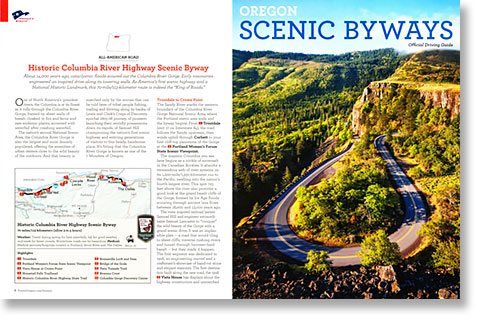
Travel Oregon Scenic Byways Guide
Client: Travel Oregon
Project: Research and write the official state guide to Oregon's 26 scenic byways
©. All rights reserved. Any use of this text, in whole or part, without written permission of the publisher and author is prohibited by law.