The Storied Au Sable River
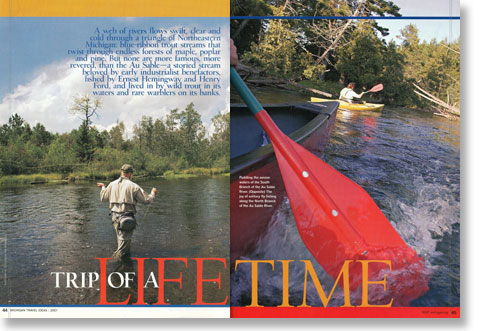
A web of rivers flows swiftly, clear and cold through a triangle of Northern Michigan, blue-ribbon trout streams that twist through endless forests of maple, poplar and pine. But none are more famous, more revered, than the Au Sable--a storied stream beloved by early industrialist benefactors, fished by Hemingway and Henry Ford, home to wild trout in its waters and rare warblers on its banks.
Fishing the North Branch
With the slightest push of a pole, fly-fishing guide Todd Fuller deftly steers our 24-foot-long Au Sable riverboat around snags, boulders and riverbends. He casts a fly rod with the same uncanny grace, the lemon-yellow line unfurling like a sine wave. What's more, he seems to know and love every inch of Au Sable's North Branch, which flows quietly through the northeast corner of Crawford County.
"Every river is unique--some are faster, narrower, more gradient, different bottom," he explains as we slide along on water the color of rich caramel. "The North Branch happens to be ideal for trout. It has lots of springs to keep the water clear and cool, and lots of gravel on the bottom for insects, which provide food. That's why it's world-renowned for fly fishing, and has been for many, many years. A hundred years ago, royalty from Europe came to the North Branch." More modern-day anglers hold it dear, too; nationwide conservation organization Trout Unlimited was founded on the banks of the Au Sable in 1959.
Many of them no doubt drifted downstream in a boat just like this one. Part Ojibwa canoe, part Cajun pirogue, the narrow, shallow-draft wooden boat was originally designed to haul supplies to logging camps along Michigan's northwoods rivers. Decades later, the efficient, graceful design was reborn as the perfect craft for fly fishing, allowing anglers to drift silently along at the pace of the current--the ideal way to sneak up on wily trout.
Todd glances up as a cedar waxwing swoops across the bow. "This stretch is just so wild," he says, with a gentle smile. "The land has been in the hands of just a few families for generations, so you'll hardly see any development along its banks. Back in the day, the landowners even had their own private game warden to patrol the river and control the fishing." Consequently, he says, the river we're floating was designated "flies only" way back in 1907, and still has the longest flies-only stretch--about 7 miles--on the Au Sable system.
These prime fishing waters run right past the front door of Todd's guiding business and fly shop, housed in a historic clapboard inn in Lovells. In the 1920s and '30s, members of the "North Branch Outing Club"--heavy hitters like Henry Ford, Thomas Edison and the Dodge Brothers--came north by railcar to fish these waters and stay at the inn, originally built in 1896 as a lumber camp store. Today, it's been restored and reborn again as Fuller's North Branch Outing Club, a wonderful lodge run by Todd's family. Sitting on the broad front porch and watching the sun glint off the river, it seems altogether plausible that Harvey Firestone just might walk by in his waders.
Todd focuses on the fishing--enticing the Au Sable's brook and brown trout to rise for a tiny artificial fly, and passing some nuggets of knowledge on to beginners like me. "There are three parts," explains Todd, as we stop at an s-curve in the river and wade along a peninsula of amber pea gravel, riffles fluttering at our knees. "You have to learn to get the fly out there--the cast. Then there's drifting the fly, so it looks natural to the fish. Then there's hooking the fish and keeping him on." Though he's no doubt explained this thousands of times, his voice quickens with excitement. "Oh, dry fly fishing is my thing," he says with a grin. "I just love watching a trout rise to take a fly."
What looks so effortless, so artful at Todd's hand--that yellow line arcing and streaming--loses all of its grace with me, the fly routinely plopping unceremoniously five or ten feet short of my casting goal. But still, I soon find I'm enamored with it all. I'm hypnotized by the drift, my gaze following the feathered fly as it bobs on the current. It's so utterly relaxing I miss at least a half-dozen strikes; I actually see the fish rise, twitch and disappear, all before I make a single move. Even when Todd shouts, "There! Now!" my reaction time is only quick enough to see the trout's open mouth, spitting out the hook.
Todd is ever-patient and encouraging, yet also seems to recognize that I'm not at all frustrated, even as he and the others reel in wriggling fish around me. "This river is so powerful," he marvels. "It's fun to see how people change when they come out here. Your focus is only on that little fly at the end of your line, and pretty soon six hours has gone by. For most people, the fishing is the bonus. It's the icing on the cake for an incredible experience."
That's exactly what I'm thinking as Todd poles us back into the current and the Au Sable guides us downstream under a canopy of cedars. The prize catch for me is to be on this river, and in this riverboat. Both are graceful, natural, seeped in history, and pure Michigan.
Paddling the South Branch
"Sportsmen, slow your pace," admonishes the weathered wooden sign that greets us at the Chase Bridge landing near Roscommon. "Ahead lies the fabled land of the South Branch...rich in tradition and ready to renew your soul. Go forth in the spirit of George Mason, whose generous gift has made this forever possible."
I'm already feeling pretty mellow as I tug the bow of my kayak into the Au Sable's gentle current. Four of us have picked one of the hottest days of the summer for a four-hour float trip down the Au Sable River's South Branch, and I'm savoring the cool water spilling around my calves.
We're about to savor the solitude, too. Just downstream begins the Mason Tract, a pristine stretch of river that flows somnolently from its headwaters north toward the mainstream of the Au Sable. Some 1,500 acres along these river banks in southeastern Crawford County was the much-loved private fishing retreat of George Mason, president of the Nash Car Company. In the 1950s, he bequeathed the entire tract to the state of Michigan, a perpetual trust that has kept it natural and undeveloped for generations. The state has subsequently added another 1330 acres to the protected tract, ensuring a wilderness experience for more than a dozen river miles.
We settle into our kayaks, bid our Watter's Edge livery shuttle driver farewell, and let the current pull us downstream. Within minutes, any road noise disappears as we sweep around a bend into a landscape of cedar, pine and sedge. There's only the buzz of dragonflies, the twitter of songbirds and the mesmerizing sound of water gurgling over rock. I soon relax my eager paddling efforts to enjoy the scenery sliding by. Before long, I pretty much abandon paddling altogether. Thanks to the easy 3-mile-per-hour current and my stable kayak, I soak up the Mason Tract beauty by dangling my toes in the water and leaning back to watch the cedar branches and sky twirl above me.
I'm jolted out of my reverie by a ruffed grouse, who erupts out of the hardwoods. We keep annoying a blue heron, too, who stares at us statue-like, then lurches into flight with few flaps of his immense pewter wings. All sorts of life thrives here: We spy an eagle's nest high in pine, and the telltale signs of river otters along the bank. "I once saw five deer swim across the river here," says Helen Burgess, one of my paddling companions. "That's what I like about kayaking--you can get so close to wildlife."
You're probably less likely to see people. Only a couple of primitive dirt roads punctuate the Mason Tract, so shoreline visitors are rare and put-ins/take-outs are few. "Once you're on the river, you're on it for a few hours," the owner of the canoe livery, Bob Stair, had said. One such road leads to the site of "Durant's Castle," a 42-room auto baron's mansion that burned to the ground in 1931. Today, its beach remains a popular swimming spot and sure enough, a family is lounging on its shores as we glide by. "Great day for a float!" one of them says in greeting. "It only gets better downstream!"
They might be right, but really, it all feels pretty perfect. We admire the lovely stone chapel built along the banks in 1957 to honor Mason. We stop for a swim in a sandy eddy. We examine scarlet wildflowers, and chartreuse grasses bending in the current. We savor the heady scent of white pine that permeates the air. All too soon we spot the bridge signaling our take-out, and Bob, waiting with a smile. We paddle to the bank while the South Branch of the Au Sable continues to roll on by.
Exploring the Lower Au Sable
The clang of loggers' axes once filled the air along the banks of the lower Au Sable, a river choked with timber headed to mills and schooners. A century later, a younger forest has matured where the tall groves of red and white pine once stood, and only the mutter of ducks paddling among reed grasses interrupts the silence along the Au Sable's shores near McKinley.
The river itself has changed, too. A few small hydroelectric dams have transformed the Lower Au Sable into a series of large serene ponds linked by a broad, gentle riverway. It's easy to get acquainted with the river as it changes and grows on its voyage to Lake Huron. Much of the lower valley--from about Mio to the river's mouth at Oscoda--falls within the Huron National Forest, so you'll find plenty of trails, overlooks and interpretive sights to guide you.
South of Glennie in northern Iosco County, the Loud Dam Pond marks the western gateway to the 22-mile River Road Scenic Byway. Heading east, I pull off at Iargo Springs, where a rambling wooden staircase leads down to freshwater mineral springs bubbling over rock and into Cooke Dam Pond. Swans glide across the placid pond, and islands of pine and birch rise up like still-life paintings, mirrored against the glassy waters.
From Iargo Springs, the Highbanks Trail skims eastward for 7 miles atop sand bluff that rises 70 feet above the river valley. I follow the footpath as far as the Lumberman's Monument (also accessible by the River Road), where three 9-foot-tall figures cast in bronze depict the three primary logging professions once commonplace along this river: the sawyer with his ax, the river driver with his peavey, and the timber cruiser with his compass. Installed in 1932, the handsome statue pays homage to the "pioneer lumbermen of Michigan, through whose labors was made possible the development of the prairie states."
I wonder if they ever took a well-deserved break at the nearby sand dune. I follow locals with beach towels to the steep sandy slope along the Highbanks Trail, then run and tumble down to water's edge for a delightful swim. Before long, though, I'm eager to continue my jaunt down the River Road. At Foote Pond, I stroll out to the overlook and am lucky enough to spot both the Au Sable River Queen paddlewheeler on her afternoon cruise, as well as a bald eagle soaring over the treetops, white tail feathers spotlighted against an enamel blue sky.
Within 10 miles, the road reaches Oscoda. The river here hardly even looks like the Au Sable I've come to know, lined with marinas, bustling with fishing boats, and then disappearing suddenly, anonymously into Lake Huron. But the beauty of a river is its timelessness. It was there for the Indians. It was there for the loggers. It was there for the anglers. And it's there for me, coiling through deep piney woods, filled with magical spots where I can sit or wade or float, lost in its tranquil, tea-colored waters.

Michigan's Au Sable River
Client: Pure Michigan
Project: A first-person feature on the different ways to experience northern Michigan's Au Sable River
©Midwest Living. All rights reserved. Any use of this text, in whole or part, without written permission of the publisher and author is prohibited by law.