The Cure For Corduroy
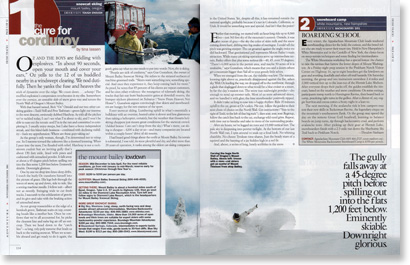
Oz and the boys are fiddling with explosives. "In about 60 seconds, open your mouth and cover your ears," Oz yells over his shoulder, then yanks the fuse and heaves the bomb over the ridge below. Our pack of 12 huddled on a windswept clearing dutifully obliges. With a muffled whump!, the compression suddenly reverberates through my ribs and, somewhere over the lip, a unstable slab of snow gives way and scours down the North Wall of Oregon's Mount Bailey.
That cornice temporarily tamed, Rick "Oz" Oswald and our two other guides--Todd Still and Pete Tashman--permit us to thread one by one along the traverse to our next descent, ominously dubbed Hardway.
Like all the pitches we tackle today, I can't see the terrain I'm about to ski, and won't be able to until I'm essentially in the run and committed to skiing it. Though I normally crave the steeps, I also have a fierce independent streak, and this blind-faith business--combined with declining visibility--adds a certain apprehension to the moment: Where in god's name are these guys sending me?
As the group's only woman, though, I'm determined not to wimp out. So I follow Tashman's directions, traversing my way toward the unknown like a doomed lemming and silently questioning whether he has accurately gauged my skiing abilities.
I peer into the maw and am flooded with relief. Hardway is not a gnarly rock-strewn couloir, but an inviting gully probably 150 feet wide, lined with pines and cushioned with untracked powder. It falls away at about a 35-degree pitch before spilling out into the flats some 1,200 feet below. Eminently skiable. Hell, for anyone craving a little powder fix, downright glorious.
One at a time we drop in, porpoising through knee-deep drifts. I watch Oz, a big burly guy who was a cop in his former life, now transformed into the picture of grace. His legs bob through the waves of snow, up and down, side to side, like a sewing machine needle. I follow suit--not nearly as sweetly--succumbing to the exhilaration of gravity and its give-and-take with the braking action of untouched snow.
As our group reassembles at the edge of a hemlock grove, Pete lags behind, counting heads like a mother hen, then making up for his duty by picking the cleanest line and nabbing air off a rocky outcrop. Then it's down to the "catch line"--a long roly-poly traverse that leads us back to the waiting snowcat--where we scramble aboard and get ready to do it all over again. Goofy grins fill the cabin, saying what no one needs to put to words: Now this is skiing.
"People are sick of the corduroy," Gus Gustafson tells me later. Gustafson has managed the operation since 1979, another entry in a varied resume that includes nearly a decade as a U.S. Forest Service snow ranger in Oregon and Alaska--working largely on avalanche control--and a stint running a private snowcat skiing operation on Oregon's Mt. Hood in the early '70s. "They want something new and different, something special. And once they experience it, they crave it and they keep coming back for more." As proof, a full 85 percent of Mt. Bailey's clientele are repeat customers.
I had heard good things about Mt. Bailey. Its terrain was substantial, I was told, its snow plentiful and dry, and it ranked among the oldest cat-ski operations in the U.S. Yet, despite all this, it had remained outside the national spotlight. It would be new, unknown, untouched. And wasn't that the point?
After a bluebird day high on the volcanic cone of Mt. Bachelor, my friend Don Placido from Hood River and I take a right in Bend and head toward Mt. Bailey, 100 miles south. It's dark when we pull into the Diamond Lake Resort, crunching icy gravel. Just five miles from the north entrance to Crater Lake National Park and at the foot of Mt. Bailey's eastern flank, Diamond Lake serves as the base camp for Mt. Bailey Snowcats.
The next morning at breakfast, a ragtag herd of skiers and snowboarders materializes, loading up on pancakes and getting fitted with powder skis. In the parking lot I get my first look at Bailey, a broad shoulder of a mountain, coated in waves like thick butter frosting.
Within the hour, we're loaded up and driving to a nearby Sno-Park, where we meet the cat and begin the hour-long climb to our destination at "Two Poles," elevation 8,000 feet--just 363 shy of Bailey's summit. Tashman spends a good half-hour going over avalanche precautions and rescue techniques. He's thoughtful and thorough, but assures us no customer yet has been caught in a slide. Still, I'm happy to strap on the beacon handed to me, which emits a signal that will allow rescuers to hone in quickly should I become buried.
I smear at the fog on the window, straining for a view. It's a ocean of gray?the sky the color of skim milk and snow coming down hard, smothering hemlocks and drifting into big swales of meringue. I can't really gauge the depth, but can tell the pitch is growing steeper. The cat groans against the angle; twice we slide backward.
That gravitational pull represents Mt. Bailey's marquee attraction. While many cat ski operations serve up mostly intermediate terrain, Bailey offers some serious tilt--40, 45, even 55 degrees. Much of the tough stuff drains down the North Wall, where 27 chutes stripe through the evergreens like skeleton's fingers.
And that?s just the beginning. Gustafson's Forest Service permit gives Mt. Bailey Snowcats 360-degree access to the mountain, including the real hairball steeps of the Northeast Face and the immense saucer of West Bowl. "There's 6,000 acres of terrain within the permit area, and maybe 50 acres of it is unskiable," Gustafson reports. Gustafson actually had plans to develop Bailey into a full-service ski area (at 7,300 acres, it would've been the largest in the U.S.) until he was stymied by the permit process. So instead, you and maybe a dozen others get a mountain bigger than Vail all to your greedy little selves.
Bailey's wildcard is the weather. The mountain gets deluged with snow--600 inches a year on average--but like most of the West Coast, it ranges from what Gustafson calls "cold smoke" to what you could politely call coastal slop. "You've still got to look at it as backcountry skiing," Oz lectures on that initial cat ride. "And backcountry ain't always perfect powder."
Uh-huh. One by one we emerge from the cat and hop down onto the snowpack at Two Poles. Visibility is tough--the summit, looming right above us, practically disappears against the flat ashen sky--but the snow seems decent. With Oz leading the way, we drop off to the northwest, through a mellow glade that doglegs down to what would be a blue cruiser at most resorts, by far our easiest run of the day.
The snow doesn't qualify as smoke--not bottomless and trippy at times--but certain passes for midweight powder, dry enough to send up rooster tails. Most of the group's largely advanced skiers handle it with glee and Don, the lone snowboarder, positively rips.
The initial unfamiliarity quickly eases into a happy rhythm: 20 minutes uphill in the cat, swapping stories and groaning at Oz's bad jokes. Pile out, follow guides to their next chute of choice on the North Wall. Get instructions ("Stay to the right of Todd, to the left of that big rock"), then one by one, soar, soar, soar. Regroup, follow catch line back to cat, exchange wild-eyed grins. Repeat.
After six hours, we've logged six runs and 15,000 vertical feet. The pale sky is deepening into pewter twilight, and too soon it's time to call it a day. At the bottom of our last North Wall run, I slowly spin around to soak in a final look. No whining chairlifts. No cheesy Tyrolean time shares. No 12-year-olds careening out of the woods. Nope, just a scatter of aspens, the beady stare of a squirrel, the harping of a jay hidden high in a spruce.
And above, a series of long, lonely scribbles in the snow.

Backcountry Skiing
Client: National Geographic Adventure
©National Geographic Society. All rights reserved. Any use of this text, in whole or part, without written permission of the publisher and author is prohibited by law.
Magazine Writing Samples

|
Isle Royale National Park |

|
Rafting the Rogue |
|
<b>Freediving</b> |

|
Slow Rides |
|
Dr. of Dirt |

|
Hiking Mt. St. Helens |

|
Backcountry Skiing |
