Blown Away
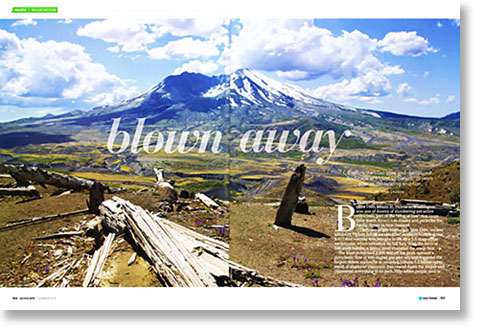
Explore the blast zone and rearranged landscape of Mount St. Helens, 35 years after its devastating eruption.
Before 1980, Mount St. Helens was one of dozens of slumbering-yet-active volcanoes, part of a "ring of fire" that loops from Alaska to Central California and encircles the Pacific.
Then one bright Washington morning in May, restless St. Helens bolted awake. After weeks of rumbling, a 5.1-magnitude earthquake shook the 9,677-foot volcano, uncorking its full fury. With the force of a thousand atom bombs, a lateral blast shattered the north face. It pulverized 1,300 feet of the peak, spewed a pyroclastic flow of 1,000-degree gas and ash, and triggered floods and mudslides, which roared down the mountain and obliterated everything in their path. Fifty-seven people died.
Thirty-five years later, you can stand in the blast zone and marvel at the power of nature, staring at what was once a perfect pyramid peak that now looks more like a flat-topped mesa. Mount St. Helens National Volcanic Monument, established two years after the eruption, encompasses 110,000 acres of the truncated mountain and its scarred surroundings, a world of both eerie entombment and astounding rebirth.
All this drama unfolded less than 100 miles northeast of Portland, Oregon. Three dead-end roads lead to Mount St. Helens--a well-traveled paved route from the west, and two well-maintained national forest roads from the south and east.
From the west, the Spirit Lake Memorial Highway (WA-504) winds 52 miles from Interstate 5 up along the North Fork Toutle River, a valley that was smothered in a superheated slurry. The road ends at the Johnston Ridge Observatory, filled with exhibits, films and compelling first-hand accounts of the eruption. Outside, the incomparable setting tells its own story: the mountain's destroyed north flank--"ground zero"--looks close enough to touch. The half-mile Eruption Trail leads out toward the crater, lava dome and landslide debris.
From the south, Forest Road 83 winds from WA-503 through the Gifford Pinchot National Forest to the Lahar Viewpoint. This barren floodplain was created by the river of mud and ash, or "lahar," unleashed by the Shoestring Glacier's torrent of instant meltwater. Continue another half-mile to road's end to explore Lava Canyon, where Muddy Creek tumbles through a tight slot of slick basalt. The 1.3-mile loop trail leads up and down ladders and across a suspension bridge. Look for rocks imbedded in debris-scoured tree trunks, proof of the deep lahar that scoured the canyon.
From the east, Windy Ridge Drive (Forest Road 99) snakes up a narrow ridge into the heart of the blast zone. Even decades later, you can still see a vast swath of destruction where the eruption toppled century-old firs like toothpicks. Spirit Lake, once a popular resort area, remains jammed with thousands of denuded tree trunks.
The road ends at Windy Ridge, directly across from St. Helens' gaping crater. Beyond the gate at road's end, follow the Truman Trail out onto an otherworldly gray pumice plain. Lupine, asters and other wildflowers push through the charred and ashen earth, once again brimming with life.

Hiking Mt. St. Helens
Client: USA Today GoEscape
Project: A short feature on a hiking destination in Washington.
©Tina Lassen. All rights reserved. Any use of this text, in whole or part, without written permission of the publisher and author is prohibited by law.
Magazine Writing Samples

|
Isle Royale National Park |

|
Rafting the Rogue |

|
<b>Freediving</b> |

|
Slow Rides |

|
Dr. of Dirt |

|
Hiking Mt. St. Helens |

|
Backcountry Skiing |
