The Dr. of Dirt
A PhD soil scientist brings the essence of fine wine back to its roots, helping vintners discover the best sites for growing grapes
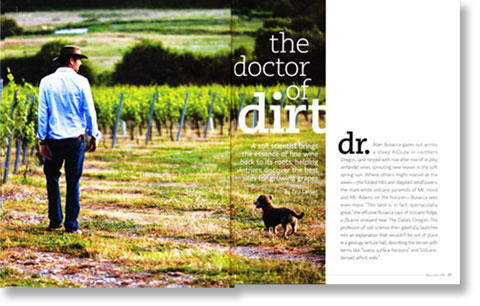
Dr. Alan Busacca gazes out across a steep hillside in northern Oregon, land striped with row after row of stubby zinfandel vines sprouting new leaves in the soft spring sun. Where others might marvel at the views--the folded hills and dappled wildflowers, the stark-white volcano pyramids of Mt. Hood and Mt. Adams on the horizon--Busacca sees even more.
"This land is, in fact, spectacularly great," the effusive Busacca says of Volcano Ridge, a 25-acre vineyard near The Dalles, Oregon. The professor of soil science then gleefully launches into an explanation that wouldn't be out of place in a geology lecture hall, describing the terrain with terms like "loamy surface horizons" and "volcanic-derived alfisol soils."
Wine's secret sauce
If wine reflects its terroir--the unique characteristics of a site's soil, climate and geology--who better to understand what makes a great vineyard than a soil scientist? Using decades of knowledge gleaned from getting his hands dirty doing field work, Busacca parlayed a teaching and research career into a unique niche: helping potential vineyard buyers and sellers determine if a particular property has that magical terroir for growing exceptional grapes.
"Raw land for a vineyard is $25,000 to $75,000 an acre," Busacca remarks. "Add another $20,000 to $50,000 to put wine grapes on it. My role is to make sure people taking those big financial steps are getting the maximum potential."
Knowing what land to buy and, within that tract of land, where specifically to plant the rows of vines, can mean the difference between grapes destined for $5 table wine and grapes that can transform into an extraordinary vintage selling for $30, $50, even $100 a bottle.
The winding route to vineyard consultant
Busacca grew up in California's Central Valley, "so I had a healthy appreciation of wine as a great beverage," he jokes. But his real love was science. He earned a geology degree at the University of California at Santa Cruz, then returned to UC-Davis to earn master's and doctorate degrees in soil science.
Busacca took a teaching and research position at Washington State University in Pullman in 1982, and began delving into the dramatic geology of the Pacific Northwest. His specialty became Ice Age geology --how cataclysmic floods 12,000 years transported minerals and built soils, "forming the skin of the earth that we farm," he explains.
Then in the late '90s, a fellow geologist (and accomplished home winemaker), Larry Meinert, came to Busacca with an idea. "He said, 'I think you and I should do a little field study of the terroir around here, and collaborate on a paper.' We didn't have a grant or anything," recalls Busacca. "We just started talking with some really formative winemakers and doing transects of their properties." They studied the specific composition of different soils, honing in on the minerals and other factors that seemed to produce the finest wines.
Their timing couldn't have been better. Southeastern Washington--then known for growing onions and potatoes--suddenly was turning heads with its wine grapes. In 2000, when Geoscience Canada published Busacca's and Meinert's paper extolling the terroir of the Walla Walla Valley, Washington winemakers ordered 5,000 copies, distributing them as far away as Burgundy, France.
"Then everything just took off," recalls Busacca. Vinitas Vineyard Consultants was born; soon Busacca was digging in vineyards from South America to Europe.
What makes winning vineyards
Today, the Walla Walla Valley is home to more than 100 wineries, many of them highly regarded. So what exactly did Busacca discover digging pits in that vineyard dirt?
He first ticks off basic vineyard requirements: plenty of sunlight, the right amount and timing of rainfall, and sloping land up off a valley floor for good water drainage and air flow. The professor's pace picks up when he gets to those Ice Age floods.
"The glaciers ground up all this fresh granite and the floods dumped the mineral particles here, layered mixtures that are young and vibrant," he explains. "Where soils have been in place for millions of years, they've leeched out their minerals. But we have this mantle of youthful soils filled with things like calcium and magnesium. It's that fresh, raw, crunched-up rock that gives character and quality to wine grapes."
Wines with a sense of place
It's an elusive enough combination of elements, suggests Busacca, that limits the high-caliber vineyard sites in North America. "I think there might be 40 states where you can make wines of some sort," he says tactfully, "and maybe eight states where you can make wines of distinction."
Busacca fully expects one of those vineyards to be Volcano Ridge, which he manages and co-owns with Lonnie Wright, an established Oregon winemaker. They planted the first 25 acres in 2008, propagating cuttings of award-winning Zinfandel vines, followed by plantings of Merlot, Chardonnay and Pinot Noir.
He's named his label "Heart Catcher Wines." As his marketing materials explain, "Alan's love of the land has taken him around the world in search of beautiful lands, Heart Catching Lands, on which to grow fine grapes and produce wines that uniquely express a sense of place."
It's a place that's brought him back to his roots, happily digging in the dirt.
Sidebar--
What's in an Name: AVAs
Of all the information packed on a pretty wine label, one designation on U.S. wines speaks specifically to terroir: its American Viticulture Area, or AVA. An AVA like California's famed "Napa Valley" or Washington's "Red Mountain" is a designated grape-growing region. By federal law, if a bottle of wine lists an AVA, at least 85 percent of its grapes must come from that specific region.
"It's a proof of identity," explains Busacca, whose field studies on soils have been used to create several Washington AVAs. "If there are certain flavor characteristics to an area, the AVA system allows consumers to seek that out with confidence." So while a Syrah from Red Mountain, with sandy soils and hot, windy exposure may be bold, dark and full of tannins, the same grape grown in the neighboring Yakima Valley AVA, with stony soils and a cooler site, will likely be brighter and softer.
"It's like French Champagne or Gorgonzola cheese," Busacca adds. "It helps you know what you're getting."

Dr. of Dirt
Client: Morgan Stanley Mosaic
Project: Profile of a soil scientist specializing in surveying land for new vineyards
©Tina Lassen. All rights reserved. Any use of this text, in whole or part, without written permission of the publisher and author is prohibited by law.
Magazine Writing Samples

|
Isle Royale National Park |

|
Rafting the Rogue |

|
<b>Freediving</b> |

|
Slow Rides |
|
Dr. of Dirt |

|
Hiking Mt. St. Helens |

|
Backcountry Skiing |
