Slow Ride
Explore the West at a natural pace-- taking a cue from the pull of the river, the curve of the trail, the tug of the breeze
"Go West" has always been shorthand for adventure. There's an energy that crackles out here, embodied in entertainment pioneers and tech-industry game changers, big-wave surfers, big-wall climbers and big-mountain skiers.
But sometimes you want to ease back on the throttle. On the following pages, we suggest a dozen experiences that will immerse you in the iconic majesty of the Western landscape--at a pace slow enough to savor it all.
Two-Wheel Appeal
Bicycles may be increasingly high-tech, but cycling still comes down to the simplest of pleasures: spinning through open air, unencumbered, an intimate and ever-changing panorama of nature. You can hear the trill of blackbirds, smell the freshly cut hay, feel the brush of a summer breeze.
Even better if you can escape the trappings of a busier world. These rides take you far from busy roads, where you can focus on the surroundings. Or focus on nothing at all.
Trail of the Coeur d'Alenes, Idaho. This 73-mile paved route (friendsofcdatrails.org)that traverses Idaho's panhandle might well be the flagship for the nation's growing network of "rail trails," non-motorized, multi-use pathways that follow abandoned railroad routes. From the western trailhead at Plummer (33 miles south of Coeur d'Alene), the trail leads away from roads and into a Ponderosa-pine-scented canyon. You'll soon skirt the shore of expansive Lake Coeur d'Alene, cross a 3,100-foot-long railroad bridge, follow the curve of the Coeur d'Alene River, and hopscotch lakes, meadows and wetlands. The asphalt is smooth, the grades are gentle and only occasionally do you cross a road or pass a cluster of cabins. Best of all, it can be quite a wildlife show on two wheels: moose, black bear, porcupine, beaver and a bounty of bird life also frequent this oh-so-scenic corridor.
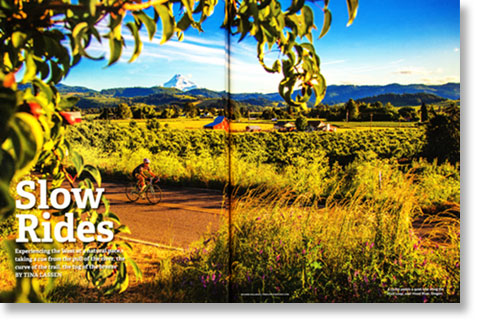
Hood River Valley, Oregon. Acre after acre of orchards and vineyards seem to unfurl as you spin along the back roads of the Hood River Valley, a lush triangle of farmlands wedged between Parkdale and Hood River north of Mt. Hood. In April, the valley explodes in white and pink blossoms of cherry, apple and pear trees. By mid-summer, fruit hangs fat on the trees and vines, and the whole valley smells like jam.
The Fruit Loop (hoodriverfruitloop.com) leads visitors on a 35-mile route through the valley, highlighting u-pick orchards, wine-tasting rooms, farm stands, cider houses and bakeries churning out heavy homemade fruit pies. Use it as your general guide, detouring off its rural highways onto smaller side roads. Straight Line Road grinds up a relentless hill, then tops out at the postcard-perfect Hood River Lavender Farms, bookended by the snow-crusted peaks of Mt. Hood and Mt. Adams. You'll use your granny gears here, but between the views and the tasting rooms, the rewards are many.
Floating Through Time
Whitewater rafting, as it turns out, doesn't have to be all that white. You just need to choose an appropriate stretch of river and the right time of year. Summer flows are typically lower and slower than spring runoff; Class II and III offer pleasant riffles and rapids, but not the hairball whitewater of Class IV or V.
Properly vetted, Western rivers can be exploratory floats, a way to penetrate deep canyons, roadless forests and distant deserts. For the full experience, sign on for a multi-day guided trip, which immerses you both in nature and the unique Western culture of a river trip: Away from the intrusions of the outside world, life syncs to the rhythm of the river.
Dinosaur National Monument, Utah. Near the Utah/Colorado border, the Yampa and Green Rivers squeeze through bluffs of ancient sandstone, rising and constricting into a snarl of twisted canyons. A raft trip like the one with Holiday River Expeditions (bikeraft.com) provides the only real route through this convoluted landscape, much of it protected as Dinosaur National Monument.
Like slicing into a layer cake, the rivers have exposed 23 different rock formations stacked up on the canyon walls. It's a geology timeline dating back 1 billion years, where you can touch some of the oldest exposed rock on earth. No surprise these canyons proved a treasure trove for archaeologists, who have discovered everything from145-million-year-old dinosaur bones to well-preserved 1,000-year-old rock art. Settle back and enjoy your own discoveries, as ancient turrets, spires and scalloped walls spiral above.
The Lower Rogue River, Oregon. The Rogue is legendary among Western rivers, renowned for its scenic canyon and superb salmon fishing. Western novelist Zane Grey had a cabin along its banks; a string of celebrities from Babe Ruth to Bing Crosby came to cast a line. Weaving westward through deep seams of rock and the dense fir forests of southwestern Oregon, the Lower Rogue became one of the nation's first "Wild and Scenic" rivers in 1968. While the federal designation prohibits shoreline development and motorized uses, the old fishing lodges were grandfathered in. Lodge-to-lodge trips like the 3-day outing with Rogue River Raft Trips (rogueriverraft.com) give you the best of both worlds: wilderness days and a warm bed at night.
Backcountry Hiking...with a Bed
Day hikes are terrific, but you can only get so far from civilization in a day's worth of sunlight. Backpacking takes care of that, but also requires a load of spendy specialized gear--tiny tents, finicky stoves, lightweight everything--that you need to schlep on your back, which also limits how far and fast you can travel.
You have other options in the West, thanks to huts and lodges hidden in the backcountry. You not only get to wake up in the wilderness, the only civilization you'll face at the end of the day is a comfortable pillow.
Glacier National Park, Montana. Glaciers and grizzlies are two of the star attractions at this Montana park, preserving some of the wildest lands in the Lower 48. Hiking through the backcountry, you might be lucky enough to marvel at both--all the more reason to spend the nights inside four real walls, not nylon ones. On a 3-day hut hike with Glacier Guides (glacierguides.com), you'll enjoy day hikes in the high alpine and nights (complete with home-cooked meals) at the Granite Park Chalet, a century-old stone lodge on the western flank of the Continental Divide.
Winterlake Lodge, Alaska. The only thing rough about Winterlake Lodge (withinthewild.com) are the peeled pine logs of the guest cabins, which scatter around a lovely lakeside main lodge that serves up fine Alaska cuisine and wellness classes. Step outside, though, and you're back in the bush--198 mushing miles from Anchorage along the Iditarod Trail, far from roads and farther from towns. You'll arrive by floatplane (50 minutes from Anchorage) with a roster of bucket-list itineraries at your disposal: Scale nearby Wolverine Ridge to gape at Denali. Hike among the lakes and fish for grayling. Board a helicopter to trek on a glacier. Is it a splurge? You bet. But not all the best things in life are free.

Slow Rides
Client: Alaska Airlines magazine
Project: A roundup of soft adventures in the Pacific Northwest.
©Tina Lassen. All rights reserved. Any use of this text, in whole or part, without written permission of the publisher and author is prohibited by law.
Magazine Writing Samples

|
Isle Royale National Park |

|
Rafting the Rogue |

|
<b>Freediving</b> |

|
Slow Rides |
|
Dr. of Dirt |

|
Hiking Mt. St. Helens |

|
Backcountry Skiing |
