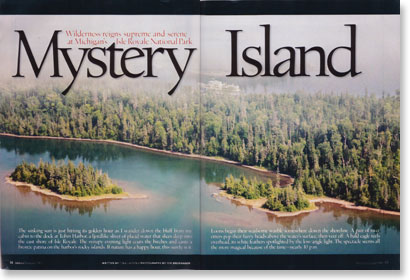
Mystery Island
The sinking sun is just hitting its golden hour as I wander down the bluff from my cabin to the dock at Tobin Harbor, a fjord-like sliver of placid water that slices deep into the east shore of Isle Royale. The syrupy light of evening coats the birches like honey, and casts a bronze patina on the harbor's rocky islands.
If nature has a happy hour, this is surely it. Loons begin their wailsome warble somewhere down the shoreline. A pair of river otters pop their furry heads above the water's surface, then vee off in a rambunctious game of tag. Soon, a bald eagle reels overhead, its white feathers spotlighted by the low-angle light. The wildlife spectacle is made all the more magical by the time--nearly 10 p.m.
Evening comes late in summer at this remote Lake Superior island above the 48th parallel. And change? Change comes hardly at all. By the time you reach your mid-forties, few things look exactly as you remember from your childhood. But Isle Royale does. It's all the same--the high rocky promontories, the hillsides of wild blueberries, the crystalline waters where my brother and I would spy on schooling trout, even the little camp store and the peculiar aqua paint on the Ranger III ferry. And Tobin Harbor, where at eight years old, I watched wide-eyed as a big bull moose trundled out of the balsams and slipped into the wild bay, fueling a wonder for this place that has never faded.
Stranded out in the vast waters of northwest Lake Superior, Isle Royale is a shining example of what a national park is meant to be: a wild, timeless, native landscape, buffered from the outside world. No development woes threaten Isle Royale's borders, and no traffic jams plague its picturesque scenery. Isle Royale National Park comprises the entire 45-mile-long island and nearly 400 smaller islets and outcrops, all of them untouched by roads and most modern conveniences. Visitors come by water or air; they travel by foot, paddle or private boat.
Standing out on the Queen's bow, watching the island slowly rise from the wide blue horizon just feels momentous--an anticipation that driving through a park gate just can't match. "Isle Royale has an island mystique that people really cherish," agrees Captain Don Kilpela, whose family has ferried passengers acroos Lake Superior on the Isle Royale Queen for more than 30 years. "It's not an easy place to get to. Yet we figure about 35 percent of our passengers are return guests--many of them multiple times."
National Park Service statistics bear him out. While Isle Royale is one of the least visited parks in the system--more people crowd into Yellowstone on a given day than visit Isle Royale in an entire season--it boasts one of the highest return rates and longest visitors stays (3 days) of all the national parks.
Many visitors arrive toting a backpack, since the park offers just one lodging option. Rock Harbor Lodge, at the island's east end within walking distance of the ferry dock, offers simple motel-style rooms, a handful of cabins, dining room, camp store and marina. The rest of the island (with the exception of a few services in Windigo, on the west end) is backcountry--a forested wilderness with 165 miles of trails, 46 inland lakes, rocky bluffs, rustic campsites and a seemingly endless scissored shoreline, all ripe for adventure.
Of course, adventure is a relative term, and many find it right in Rock Harbor. Outside their door, lodge guests can choose from several great day hikes. ranger-led boat excursions and paddling protected bays in the resort's rental canoes. I immediately set off for Scoville Point, a 4.2-mile hike that traces a bony finger of land not a quarter-mile wide, the air thick with the spicy scent of spruce and juniper. A dozen or so small islands scatter off the point, where I sprawl on a broad slab of sun-warmed granite to the sounds of wind through creaking cedars and waves washing over lichen-splattered rock.
Back in Rock Harbor, guests are buzzing with stories of the big cow moose with twin calves that just strolled right past the marina. While the island's wolves are shy and stealthy creatures, visitors often spot moose, which seem almost nonchalant around humans. They regularly browse among the cabins and have been known to stroll past the outdoor amphitheater, summarily upstaging the ranger giving an evening nature talk. (Still, give wide berth to these 1,000-pound mammals, which can be exceptionally dangerous if they feel threatened.)
Most scientists believe that moose swam to Isle Royale from Ontario in the early 1900s, followed by the eastern timber wolves that across on pack ice a couple of decades later. Largely free from the effects of civilization, Isle Royale serves as an ideal living laboratory for researchers. Since 1958, they've analyzed the natural ebb and flow relationship between moose and wolves, considered one of the longest-running predetor/prey studies ever conducted. Isle Royale's moose population currently stands at about 900 animals; wolves number about 14, divided into three packs.
As a water-based park, Isle Royale offers a unique twist on the typical national park scenic drive. The 40-foot MV Sandy casts off from Rock Harbor every day in high season, cruising out to various islands and ranger-led interpretive hikes. I sign on for the North Side Cruise, an all-day adventure that rounds Isle Royale's ragged northeastern shore, shredded by centuries of glacial advances and retreats.
Captain Ron Gedda deftly threads the Sandy through a crazy quilt of narrow channels and scalloped islands, then into McCargoe Cove, a gorgeous slot of water that cleaves into the north shore. Five backpackers relax at water's edge, awaiting a water taxi after two weeks in the woods. Nelson "Jim" Decker of Fairbanks, Alaska, is completing his 30th trip to the island. "I catch grief from my friends in Alaska that I come here to go camping in the woods," he says. "But my father first brought me here as a boy in 1963 and it just took a hold of me. My house is filled with photos and maps of Isle Royale. It's my church. It's my home. It's where I come to recharge."
Because I'm eager to explore more of the island, I opt to hike the 17 miles back to Rock Harbor from McCargoe, rather than return on the Sandy. With a good supply of water and other supplies in my daypack, I bid farewell to Capt. Ron and set off south toward the Greenstone Ridge.
Hikers get a crash course in the island's geology. North-south trails continually rise and fall over a series of ridges and troughs; the Greenstone Ridge Trail, on the other hand, remains relatively level as it traces a high east-west ridgeline across the island. This unusual washboard topography began forming some 2 billion years ago, a product of spewing volcanoes, colliding continents and seeping lava flows. This layered crust of basalt eventually cracked, thrusting the earth upward at an angle. One on side of the fault rose Isle Royale, with a northwest side of steep ridges and bluffs, and a southeastern shore that slopes in ripples to the water. On the other side of the fault rose the Keweenaw Peninsula, its topography a near mirror image of Isle Royale. The basalt found in both is believed to be some of the oldest exposed volcanic rock on earth.
The geologic story translates to ever-changing scenery on the trail. In the troughs, fat lily pads loll in tea-colored wetlands, surrounded by marsh marigolds, iris and remarkable ladyslipper orchids. On the drier ridges, wild roses, daisies and yellow hawkweed bob in the breeze. When I reach the Greenstone Ridge--the island's high spine--the forest gives way to vast Superior views and open meadows erupting a June riot of asters, paintbrush, lilies, clematis and yarrow.
The Greenstone Ridge is the island's main street, a 42-mile footpath that spans the island from east to west and links together a variety of backpacking routes. Often the trail isn't really a trail at all, but immense humps of bedrock that rise from the soil like surfacing whales. It makes for easy walking, and my hike lulls into a contented, carefree rhythm.
There's nothing like a long hike to refresh the spirit, and the lengthy, lightly traveled trails of Isle Royale are the perfect antidote to frenzied lives. Stress dissipates with each footfall; thoughts of schedules and responsibilities slowly erase into white noise. I just walk and be--smelling the wild honeysuckle, feeling the breeze, enjoying the song of a warbler, admiring the pattern of ferns silhouetted against rock like fish skeletons.
Soon, the old firetower on Mt. Ojibway rises above the treeline, now used as an air-monitoring station. From the tower, a tableau of blue and green spills out in every direction: coves and islands, inland lakes and fir-covered hills, the hazy Canadian shore and the grandest of the Great Lakes, spilling off to the horizon.
So wild now, but Isle Royale has a long history of inhabitation. Native Americans mined the island's rich veins of copper for more than 1,000 years; their hand-dug pits are still evident throughout the park. More sophisticated mining operations sprung up in the early 1800s, as did commercial fisheries. Tourism bloomed at the turn of the century, with Great Lakes steamers ferrying city folk to island resorts complete with dance halls, bowling alleys and pitch-and-putt golf courses. Rock Harbor Lodge is the only survivor of the era.
Summer homes flourished, too, especially in the protected waters of Tobin Harbor. Only a handful of these homes remain, grandfathered in since the National Park Service began acquiring Isle Royale land parcels in 1931. Mary Merritt Scheibe is one of the park's "life leasees." She grew up summering on the island before the national park service arrived, so still maintains the family cabin with her husband, Dick.
"My grandfather was a copper miner here in the mid-1800s, then a timber cruiser," Mary says, steering the outboard east down Tobin Harbor as she's done for decades. "Then he fell in love with Isle Royale and started buying islands." Eventually, she says, he owned 12, and the family legacy is scattered throughout the east end of Tobin Harbor--Merritt Island, the original homestead; Glen Island, named for Mary's father and site of the family cabin; Boys Island, named for two brothers, Anna's Island for one of the sisters, and so on.
"We were a strong community," Mary recalls. "Isle Royale to me is people and water." She remembers Saturday night fish fries, playing with the commercial fisherman's daughter from the next island and fishing with her brother, Grant. "We didn't go far--our life was here in Tobin. But we spent a lot of time in the boat. It meant everything to us. We were free."
Mary's words ring in my ears as I dip my paddle in Rock Harbor and slide away from the land. Sea kayaking may be the ideal way to explore Isle Royale, providing the freedom and solitude of backpacking, but with your gear in your boat instead of on your back. I relish the watery vantage point it provides--cutting through the waves, one with the water, the shoreline scenery mine to enjoy and explore at whim.
Superior's waters are not to be taken lightly, though, so best to sign on with guided trip like those offered by Keweenaw Adventure Company. With guide Brian Cygan at the lead, six of us glide west along Isle Royale's south shore toward a campsite on Caribou Island. Having easy access to the national park's smaller islands is another benefit of kayaking, and Caribou is a beauty. We spend our first afternoon scouting our mile-long private domain, scrambling among its nook-and-cranny shoreline.
Caribou becomes our base camp for three idyllic days. It puts us within easy striking distance of several great paddling destinations: the 1855 Rock Harbor Lighthouse, now housing a small museum; the restored Edisen Fishery, showing what life was like for the small, family-owned commercial fisheries that thrived here in the mid-1900s; and the Wolf Research Station, researcher Rolf Peterson's field base, its grounds filled with wolf skulls and moss-covered moose antlers.
We also happily paddle nowhere in particular, wherever wind and waves dictate safe passage. We ease along Superior's high bluffs, gazing down into 30 feet of jade water clear as a swimming pool. We lunch in secluded coves and hunt for greenstones, turtleshell-patterned pebbles found only a few places in the world. We bushwhack through the backcountry, where my university botanist paddling partners happily identify dozens of wildflowers; Isle Royale is home to several rare species. We even swim--unusual for frigid Lake Superior--in the sun-warmed shallows of Conglomerate Bay. Each evening, we return to our camp on Caribou, drifting off to sleep to the distant clang of a bell buoy.
Back home in my own bed, I miss that haunting sound. I miss the island. But I know the bell, and the big water, and the ancient rock, and everything else I love about Isle Royale will be there, just the same, when I return.

Isle Royale National Park
Client: Midwest Living Magazine
Project: A first-person travel feature about Michigan's Isle Royale National Park
©Meredith Corporation. All rights reserved. Any use of this text, in whole or part, without written permission of the publisher and author is prohibited by law.
Magazine Writing Samples
|
Isle Royale National Park |

|
Rafting the Rogue |

|
<b>Freediving</b> |
|
Slow Rides |
|
Dr. of Dirt |

|
Hiking Mt. St. Helens |
|
Backcountry Skiing |
